
The Inverted Bubble: Why AI's Problem Is the Opposite of Dot-Com's

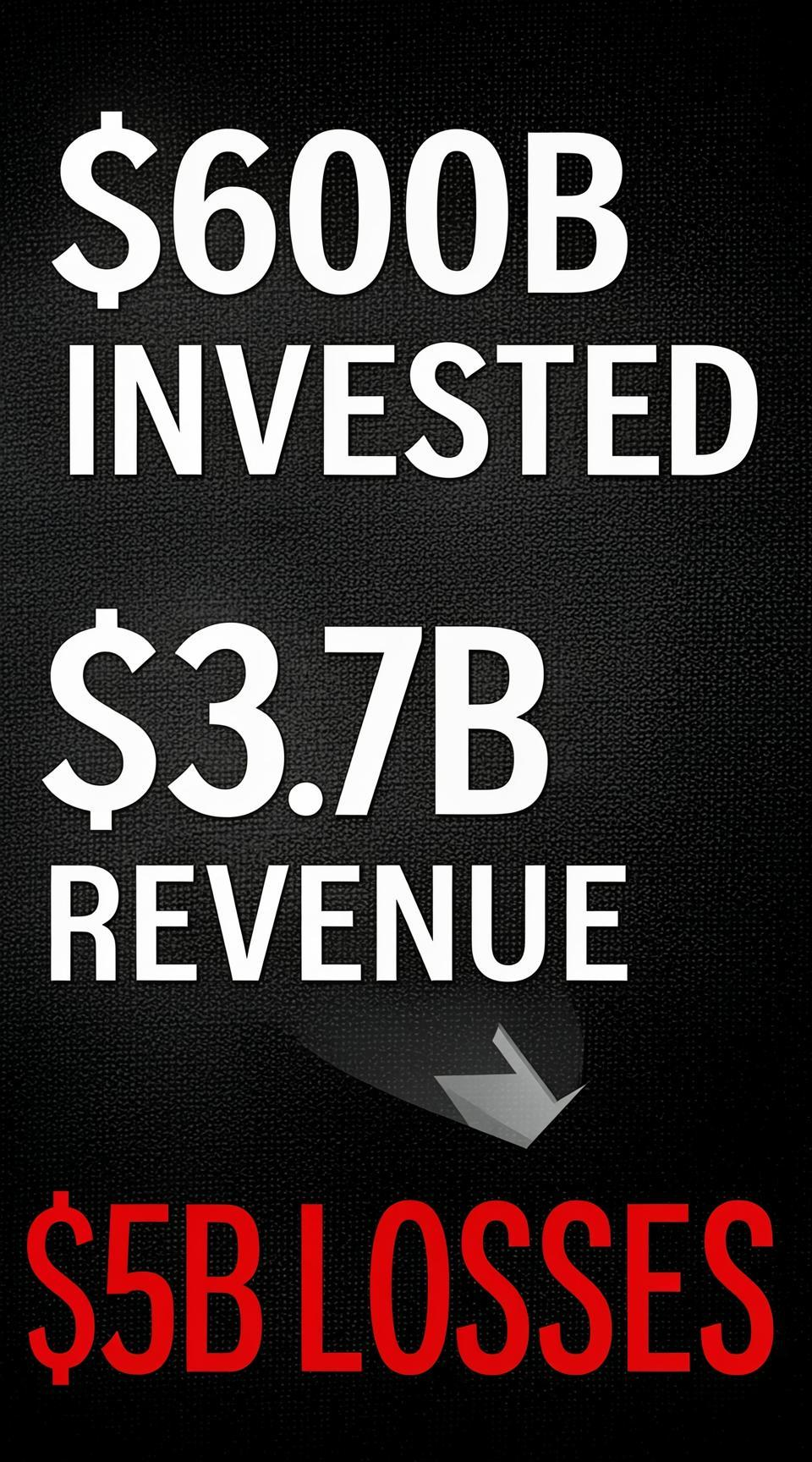
Everyone's calling AI a bubble. They might be right for the wrong reasons.
The last time we saw this pattern, $5 trillion in market cap vanished in 18 months. The NASDAQ fell 78%. Half of all dot-com companies disappeared.
Today, the same signals are flashing in AI stocks—but there's a twist nobody's talking about.
The dot-com bubble burst because prices were fake. The AI reckoning will happen because prices were too real—just temporarily suppressed by vendors burning billions to buy market share.
This isn't another "is AI a bubble?" think piece. This is about why the mechanics of any coming correction are the exact opposite of 2000—and what that means for anyone building on AI infrastructure.
The Dot-Com Playbook: When Prices Were Fiction
In 1999, "business.com" sold for $7.5 million [1]. "Hotels.com" fetched $11 million [2]. These weren't prices based on cash flow or earnings—they were bets on future scarcity in a digital gold rush.
The logic was circular: domains were valuable because people believed they were valuable. Prices kept rising because prices kept rising.
The numbers were staggering:
| Metric | Dot-Com Bubble |
|---|---|
| NASDAQ decline | 78% (5,048 → 1,140) |
| Market cap erased | $5 trillion |
| Companies that survived | 48% |
| Recovery time | 15 years |
| P/E ratio at peak | 200x |
The bubble didn't burst because the internet stopped being important. It burst because the prices were never real. Companies built business models assuming valuations that existed only in a speculative feedback loop.
When reality intruded, everything collapsed.
AI's Inverted Problem: Prices That Make Too Much Sense
Here's where it gets counterintuitive.
The AI industry isn't suffering from prices that exceed value—it's suffering from prices that dramatically understate value.
Consider what generative AI actually delivers:
| Task | Human Cost | AI Cost |
|---|---|---|
| Software developer | $150,000/year | $19/month (Copilot) |
| 2,000 words of copy | 1 day of work | 30 seconds, pennies |
| Contract review | $400/hour | ~$0.01/page |
Research from Andreessen Horowitz suggests generative AI offers 4-5 orders of magnitude cost reduction compared to human labor [3]. That's not a pricing error—that's an economic transformation.
So why is this a problem?
Because someone is subsidizing the gap between what AI costs and what it's worth. And that subsidy is running on fumes.
The Real Numbers: AI's $600 Billion Gap
In June 2024, Sequoia Capital published "AI's $600B Question" [4]. The analysis was brutal: the industry had invested approximately $600 billion in GPU infrastructure, but actual AI ecosystem revenue was nowhere close.
The gap has only grown since then.
The Vendor Burn Rates
| Company | Revenue (2024-25) | Losses | Valuation |
|---|---|---|---|
| OpenAI | $3.7B (2024) → $12B (2025) | $5B net loss (2024) | $500B |
| Anthropic | $14B (2025) | Undisclosed (raising constantly) | $380B |
OpenAI projects $8 billion in operating losses for 2025, with cumulative spending of $115 billion through 2029 before reaching cash-flow positivity [5].
Running ChatGPT costs approximately $700,000 per day in computing costs alone [6].
The Infrastructure Bets
The numbers are staggering:
- Microsoft: $13+ billion invested in OpenAI (27% stake)
- Amazon: $8 billion in Anthropic
- OpenAI-Oracle: $300 billion computing deal over 5 years
- GPU prices: H100 chips at $25,000-30,000 list, up to $70,000 at peak shortage
The uncomfortable truth: These investments weren't charitable. Investors expect returns. At some point, the math has to work.
The Vendor Subsidy Trap
When OpenAI charges $20/month for ChatGPT Plus or offers API access at rates that barely cover computing costs, they're not operating a sustainable business—they're buying market share.
This is a classic technology playbook: lose money on each customer until you achieve monopoly pricing power, then raise prices.
The strategy works when:
- You have a durable competitive advantage
- Switching costs for customers are high
- You can raise prices without losing your customer base
The problem for AI vendors? None of these conditions hold.
No Durable Advantage
The gap between frontier models is shrinking. Claude, GPT-4, Gemini, and Llama all achieve similar performance benchmarks. When products are roughly equivalent, pricing power evaporates.
Low Switching Costs
Most AI applications are thin wrappers around API calls. A startup using GPT-4 can switch to Claude or Gemini in an afternoon. Yes, some embeddings need re-indexing. Yes, some work has to be done—it's not a magic switch. But there's no massive barrier.
The Pricing Death Spiral
API prices haven't just fallen—they've collapsed. And open-source alternatives are pricing at a fraction of what OpenAI charges:
| Model | Input ($/1M) | Output ($/1M) | vs OpenAI GPT-5.4 |
|---|---|---|---|
| OpenAI GPT-5.4 | $2.50 | $15.00 | Baseline |
| OpenAI GPT-5.4 nano | $0.20 | $1.25 | 92% cheaper |
| DeepSeek-V3 | $0.14 | $0.28 | 96% cheaper |
| GLM-4.7-FlashX (Zhipu) | $0.07 | $0.43 | 97% cheaper |
| Llama-4-Scout (Meta) | $0.08 | $0.30 | 98% cheaper |
| Qwen3-8B (Alibaba) | $0.07 | $0.29 | 97% cheaper |
Sources: OpenAI Pricing [8], DeepSeek API, Zhipu AI BigModel, DeepInfra, Groq (March 2026)
The numbers are stark: Chinese open-source models like GLM and Qwen are pricing at 97-99% below OpenAI's flagship. Even OpenAI's own budget tier (nano) can't compete with free.
This is great for AI users but catastrophic for vendors trying to maintain premium pricing.
The result: Vendors can't raise prices because open-source alternatives are 97% cheaper, but they can't maintain current prices because costs exceed revenue. This is a pricing death spiral.
The Startup Time Bomb
Here's where the real damage will occur.
Thousands of startups have built business models assuming AI API costs will remain low. Consider the typical AI-powered SaaS company:
- Charges customers $50/month
- Pays $10/month in AI API costs per customer
- Operates on a 20% margin
This works fine when API costs are stable. But what happens when OpenAI, Anthropic, or Google need to stop burning cash?
If API costs double to $20/month, that startup's margin doesn't shrink by half—it disappears entirely. They're now losing money on every customer.
Unlike traditional software, where marginal costs approach zero, AI-powered businesses have real marginal costs tied to inference. Every user interaction requires GPU compute. Every additional customer increases the vendor's cost structure.
Why Prices Must Rise
The current AI pricing regime is mathematically unsustainable:
| Factor | Reality |
|---|---|
| Infrastructure depreciation | H100 costs $25K-40K, obsolete in 2-3 years |
| Energy costs | Massive electricity consumption at current pricing |
| Investor expectations | $600B+ in GPU infrastructure needs returns |
| Competitive dynamics | Everyone trapped in a prisoner's dilemma |
Even if one vendor wants to maintain low prices, they need competitors to exit first. No one can afford to blink.
At some point, prices must rise. The only question is when and how dramatically.
The Coming Margin Squeeze
When AI vendors raise prices—and they will—the consequences will cascade:
Layer 1: Direct Impact
Companies depending on AI APIs as a core input face immediate margin compression. Many become unprofitable overnight.
Layer 2: Competitive Reshuffling
Startups that built moats around AI capabilities find those moats draining. If everyone has access to similar AI at similar prices, differentiation becomes about distribution, branding, and network effects—the traditional startup battlegrounds.
Layer 3: Valuation Reckoning
Investors who valued AI startups at premium multiples will reassess. The multiple compression could be severe.
Layer 4: Consolidation
Well-capitalized companies acquire distressed AI startups at discounts. The technology survives, but many founders and early employees lose equity value.
Why This Is Messier Than Dot-Com
The dot-com bubble was painful but clean. Overvalued companies went bankrupt, investors lost money, and the industry moved on.
The AI "implosion" may be messier because:
| Factor | Dot-Com | AI |
|---|---|---|
| Technology value | Often non-existent | Genuinely valuable |
| Subsidy source | Public market speculation | Vendors and VCs (harder to predict) |
The technology won't disappear—but business models built on it will need fundamental restructuring.
The Paradox of Real Value
The dot-com bubble burst because prices were fake.
The AI reckoning will happen because prices were too real—just temporarily suppressed by vendors who can't afford to keep subsidizing them.
This is the paradox at the heart of the AI economy: the technology delivers extraordinary value, but the current pricing doesn't capture that value sustainably.
Something has to give.
When it does, the companies that prepared for higher costs will survive. The ones that assumed AI would remain forever cheap will discover that subsidies, like bubbles, eventually end.
What Would Change My Mind
I could be wrong about the timing and severity. Here's what would make me more optimistic:
- OpenAI reaches profitability before 2029 — If they crack the unit economics faster than projected, the subsidy thesis weakens
- GPU costs collapse — If hardware becomes dramatically cheaper, the margin pressure eases
- A killer app emerges — If an AI application generates $100B+ in revenue, the $600B gap starts to close
- Consolidation reduces competition — If 2-3 players dominate and can exercise pricing power, the death spiral ends
I'll be watching these indicators closely.
The question isn't whether AI will transform the economy—it already has. The question is whether your business model will survive the transformation.
References
[1] Wikipedia - Dot-com Bubble: Domain Sales. https://en.wikipedia.org/wiki/Dot-com_bubble
[2] Investopedia - Dotcom Bubble: Market Statistics. https://www.investopedia.com/terms/d/dotcom-bubble.asp
[3] Andreessen Horowitz - The Economic Case for Generative AI. https://a16z.com/the-economic-case-for-generative-ai/
[4] Sequoia Capital - AI's $600B Question. https://www.sequoiacap.com/article/ais-600b-question/
[5] Wikipedia - OpenAI: Financial Data. https://en.wikipedia.org/wiki/OpenAI
[6] Industry Reports - ChatGPT Operating Costs (2023)
[7] Wikipedia - Anthropic: Funding and Valuation. https://en.wikipedia.org/wiki/Anthropic
[8] OpenAI API Pricing. https://openai.com/api/pricing
[9] DeepSeek API Pricing. https://platform.deepseek.com/api-docs/pricing
[10] Zhipu AI (GLM) Pricing. https://bigmodel.cn/en/pricing
[11] DeepInfra API Pricing. https://deepinfra.com/pricing
[12] Groq API Pricing. https://groq.com/pricing